
Patent Bolsters Chances of Chemicals From Biodesulfurization
The patent covers the biochemical production and use of a class of compounds called hydroxy phenyl benzene sulfinate (HPBS). HPBS can be used as a hydrotrope in concentrated detergents to keep surfactants in suspension, or derivatized to improve its surfactant properties.
"It does some of same things as conventional sulfonate surfactants, but costs less," says Energy BioSystems VP R&D Dan Monticello. "It has some unique properties, and may have some functional advantages over other materials."
Valdez
The patent could not have come at a better time. The company plans to construct a 5000 bbl/d biodesulfurization facility at Petro Star Inc.'s 38,000 bbl/d Valdez, AK, refinery. Petro Star, a subsidiary of Arctic Slope Regional Corp., supplies Alaska with marine diesel, military jet fuel, heating oil, and middle distillates.
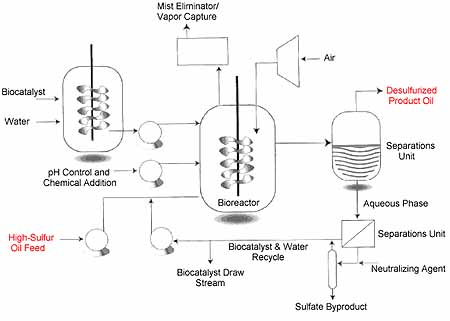
Faced with Federal regulations calling for reduction of sulfur in diesel fuel to 500 ppm, the small refiner could not afford a capital-intensive hydrotreater. Instead, it opted for biodesulfurization. Energy BioSystem's process mixes a 1:1 ratio of diesel and water into a bioreactor filled with enzymes. Within a few hours, the enzymes oxidize the alkylated dibenzothiophenes in diesel into HPBS.
Several large companies have also formed alliances with Energy BioSystems. According to Monticello, they are more interested in reducing sulfur content down to the 50 ppm in anticipation of newer, more stringent regulations.
The company has alliances with Total Raffinage Distribution, SA, part of Total Fina, to create a diesel biodesulfurization process. It has a similar deal with Koch Refining Co. to develop a similar process for gasoline. A third deal, with Texaco Exploration and Production Technology Development, seeks to use enzymes to remove sulfur from high-sulfur crude oil.
HPBS Opportunities
When Energy BioSystems enzymes contact diesel fuel, they convert a heterogeneous mixture of alkylated dibenzothiophenes into a heterogeneous family of hydroxy phenyl benzene sulfinates decorated with a distribution of short alkyl chains. Energy BioSystems then separates the diesel fuel from process water, then purifies and dries the HPBS mixture into a concentrated form.
The HPBS structure consists of two aromatic rings. One ring contains a sulfinate (SO2), the other a hydroxyl. The molecules act like hydrotropes, keeping surfactants in suspension.
"Their awkward configuration of short alkyl chains breaks up the formation of liquid crystals by of other surfactants," explains Energy BioSystems chemist Elaine Lange. That makes them useful in concentrated detergents, where surfactants tend to come out of solution. The sulfinate moiety also adds surfactant properties of its own.
Energy BioSystems also adds hydrocarbon chains by traditional chemistry. "The biphenyl structure gives you two functional moieties to derivatize," says Monticello. "You can alkylate with an ester or ether and attach a long hydrocarbon chain, so you wind up with a sulfinate on one end and long hydrophobic group on the other. And that's the definition of a surfactant."
Because of low capital costs and byproduct pricing structure, Monticello believes the materials could have an advantage against conventional linear alkyl sulfonate (LAS) surfactants. "There are lots of possible applications, and we're interested in talking to people about them," he says.
Biodesulfurization
The company's biodesulfurization process traces its roots back to the late 1940s, when researchers first attempted to use microbes to break the carbon-sulfur bonds in petroleum. Unfortunately, the microbes were indiscriminately ravenous, attacking hydrocarbons as well as thiophenes.
In 1988, researchers sponsored by the Dept. of Energy found two strains of bacteria that selectively desulfurized fossil fuels. In 1991, Energy BioSystems obtained exclusive worldwide rights to these microbial strains. The company quickly cloned, sequenced, and characterized the relevant genes. Through then transferred them into more vigorous hosts and genetically engineered them to increase expression.
By the end of 1994, the company had a fully integrated 5 bbl/d desulfurization pilot plant up and running. The company used the plant to generate engineering information to improve future designs.
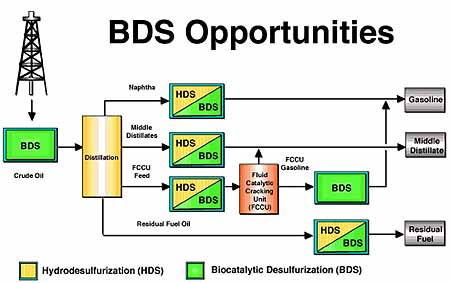
It has also done some economics. The typical hydrodesululfurization (HDS) plant, it notes, costs $50-80 million. Its high pressures and temperatures make it expensive to maintain. Some refineries may also have to invest in additional hydrogen production capacity since hydrogen consumption rises dramatically as refineries try to push down sulfur levels.
Biodesulfurization has some advantages. It costs about 50% less to build and 10-20% less to operate. Construction time is only 12-18 months, compared with 24-36 months for HDS. It handles a broad range of petroleum streams and emits less greenhouse emissions. Most important, though, it removes those sulfur-containing compounds that are the most difficult for HDS to treat.
The company's recent patent allowance covers both biochemical production and applications.
"This is the first in a series of potential patents that form the basis of the company's strategy to gain a proprietary position for the biocatalytic production of chemicals," says company president/CEO Peter Policastro. "This patent both validates and strengthens our efforts to leverage our biocatalysis expertise and to commercialize these 'biopetrochemicals.'
"HPBS has the potential to bring significant revenue to oil refiners who aim to remove sulfur from fuels, thus increasing the value of BDS relative to traditional desulfurization technologies. For the chemical manufacturers, it offers a competitive advantage by introducing low-cost products with unique features into existing markets," he concludes.
For more information: Daniel J. Monticello, VP, R&D, Energy BioSystems Corp., 4200 Research Forest Dr., The Woodlands, TX 77381. Phone: 281-364-6160. Fax: 281-364-6114. Email: djmdoc@aol.com.
By Alan S. Brown