
Heat-exchanger Redesign Ups Capacity by 11.7% at LNG Plant
LNG produced by the Bontang facility is sold as a readily transportable source of natural gas, primarily to Japanese interests. VICO Services, Inc. (Houston), as a gas producer, provides engineering and technical assistance and personnel to P. T. Badak. The redesign included finned titanium tubing from High Performance Tube, Inc. (Warren, NJ), and RODBaffle tubing supports, a trademarked technology of Phillips Petroleum Co. (Bartlesville, OK).
Bontang is a coastal facility, to facilitate shipping the finished product to overseas customers and utilize the sea as cooling-water supply for the plant's heat exchangers. Some critical heat exchangers, like those of most existing coastal plants, were originally supplied with corrosion- and erosion-prone copper-nickel tubes. Designers recognized that production could be increased and downtime reduced by replacing existing heat exchangers with new exchangers featuring the latest materials and design improvements. The corrosion and erosion resistance of titanium made it the material of choice for tubes and tube sheets in this seawater cooling service. P. T. Badak had some previous experience with replacing copper-nickel heat exchangers with titanium, which had proved very successful.
Enhanced heat transfer
High Performance Tube's Fine Fin tubing is produced from stock smooth titanium tubing. Fins are formed on the bare tube in an extrusion process. The spinning tube is cold-rolled under pressure by dies. No metal is removed and no stress risers introduced, but the low-profile fins provide the tube with much greater heat-transfer area. A finned tube offers up to three times the heat transfer surface of a similar length of bare tube.
As a result, finned tube makes exotic metals such as titanium available in a less costly form. Because of the extended heat-transfer surface, finned tube costs about half the price of smooth tube per square foot of heat transfer surface, according to High Performance Tube.
Finned tubes have other advantages. The fins strengthen the tube so it withstands greater collapse pressure and better resists denting and flattening. Greater internal burst resistance has also been confirmed. Titanium itself forms a hard, smooth surface oxide film, enhancing seawater flow on the tubeside. The finned tubes decrease fouling on the shellside. The fin configuration tends to be self-cleaning: scale, and fouling matter such as oil entrained in the gas stream, are less likely to adhere to the surface of the fins. In many cases adhesions are broken up and carried away by the gas stream. If scale does form, it is easily washed off; in the worst case, finned tubes clean as quickly as bare tubes.
At Bontang, these finned tubes were installed in a RODbaffle design, which locks tubes into place. This design goes far toward eliminating damaging vibration, and shellside pressure drop is lower than with a conventional plate-baffle design.
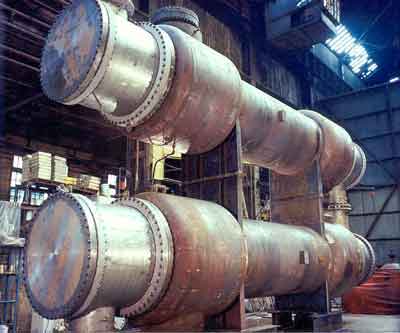
The original foundation and supports were employed. The extended heat-transfer surface was packaged into an exchanger shell that exactly - within 0.06-in. tolerance - fits the envelope of the old exchangers. As a result, minimum reworking was required to attach the 30-in. shellside and 24-in. tubeside connecting pipes.
Advantages of the redesign
In general, heat exchangers utilizing lighter-weight finned tube have a smaller diameter shell and smaller envelope. The result is less structural foundation loading, and in some cases less piping and fewer shells.
The improved design requires less maintenance. Fewer, smaller heat exchangers save on rigging and removal of covers for inspection, and cleaning of tubes. And use of finned titanium, compared with a lesser metal such as copper-nickel, results in a smaller, more compact unit with longer life.
At the Bontang LNG plant, tests confirmed that the redesigned heat exchangers with the Fine-Fin tubing and Phillips RODbaffle allowed an additional increase in production over and above the design goal. Instead of 9.8% more product, the re-engineered train is now achieving an 11.7% increase in production.
Edited by Nick Basta
High Performance Tube, Inc., 95 Mount Bethel Rd., Warren, NJ 07059-0512. Phone: 908-561-2111. Fax: 908-561-2219.
Phillips Petroleum, Phillips Bldg., Bartlesville, OK 74004. Phone: 918-661-6600. Fax: 918-661-6279.